


Prostatitis is one of the most unpleasant ailments of the male reproductive system.Thanks to poor nutrition, physical inactivity, bad habits and other negative factors present in the lives of modern representatives of the stronger sex, the widespread prevalence of this pathology is constantly increasing.
Eliminating the symptoms of prostate disease is quite easy, the main thing is to start treatment on time.That is why any man must know the first signs of prostatitis, as well as all the reasons due to which this disease can occur.
General information
Prostatitis is a common infectious and inflammatory lesion of the prostate gland.But not all patients know that this pathology poses a great, hidden threat to the health of the male reproductive system.The prostate is a pelvic organ that is closely adjacent to the vas deferens and the urethral canal and connects to them.Therefore, the presence of infection in this gland can negatively affect the condition of the organs and systems nearby.
Until recently, experts claimed that prostate diseases in men occur only between the ages of 40 and 60, but these days this disease has become much younger.Now doctors are increasingly voicing a similar diagnosis to very young representatives of the stronger sex, whose age is 18-30 years.
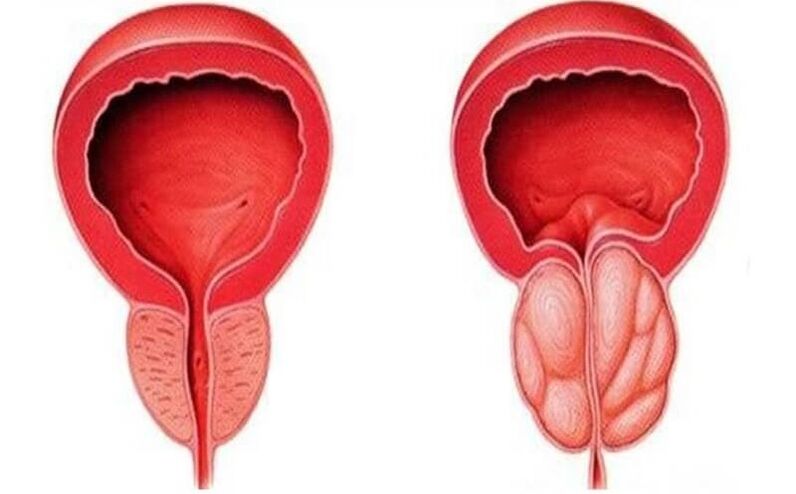
Why did the symptoms of prostatitis begin to appear for the first time at such an early age?The answer to this question lies in the too careless, inattentive attitude of men to their health.Research by scientists in this branch of medicine has shown that about 80% of male patients completely ignore the first signs of pathology.The majority of patients seek qualified help from a doctor only at advanced stages of the inflammatory process.And in such situations it is already very difficult to completely avoid severe complications of the disease.
What is causing this problem?
A variety of factors can provoke the appearance of signs of prostatitis in men.Some of them create favorable conditions for harmful microorganisms of bacterial, viral or even fungal origin to enter the organ - others cause disruption of the gland and lead to stagnation of blood in it.The result of this negative impact is increased reproduction and growth of pathogenic microflora, as well as progression of the disease.
Inflammation of the prostate in males develops under the influence of the following reasons:
- Untimely and irrational nutrition, lack of necessary microelements and vitamins.
- Infections transmitted through sexual contact (syphilis, gonorrhea, HIV, trichomoniasis, chlamydia).
- Severe hypothermia of the entire body or genitourinary system.
- Physical inactivity and congestion in the pelvic area.
- The patient has recently suffered from pathologies: colds, flu, acute respiratory viral infections.
- Wrong lifestyle, bad habits.
- Disruption of the hormonal system (leads to insufficient testosterone secretion).
- Chronic diseases of the reproductive system in a sexual partner.
- Prolonged absence of sex or overly active sex life (in both the first and second cases, the factor can contribute to the development of prostatitis symptoms).
- Frequent stress and constant psycho-emotional tension.
- Hard physical work, prolonged overwork.
- Infectious and inflammatory diseases of other organs.
Interesting!Urethral reflux can also cause symptoms of prostatitis in men.This phenomenon is caused by a disruption in the normal functioning of the prostate, due to which the organ loses its ability to prevent urine from flowing in the opposite direction.As a result, urine is thrown into the prostate gland, along with an infection from the urethra.Urethral reflux occurs due to improper placement of the urinary catheter or inflammation of the urethral canal.
How to determine the onset of this disease?
Signs and symptoms of prostatitis can be hidden or overt.This property of the disease is explained by the individuality of each patient’s body: age, the presence of bad habits or chronic pathologies, the state of immune defense and other specific factors.The very first signs of the disease most often appear 3-4 days or 1-2 weeks after the onset of the inflammatory process.Clinical manifestations of this disease include the following symptoms:
- weakness, poor health;
- pain in the lower abdomen;
- excessive urination with false urges;
- problematic urination;
- the presence of discomfort in the lumbar region, scrotum;
- the occurrence of pain along the urethral canal, which is associated with the process of urine output;
- slight swelling of the genitals;
- increase in temperature indicators (can be observed for a short time);
- incomplete emptying of the bladder.
At the initial stage, the manifestations of prostatitis are often confused with symptomatic signs of pathologies of the urinary system or other infections.This is why representatives of the stronger sex in most cases postpone a visit to a specialist indefinitely.During this period, men treat the disease independently, based on the prevailing symptoms - for this purpose they take analgesics and antipyretic medications.
To learn how to accurately identify impending inflammation of the prostate gland, you need to know several important manifestations of this disease.The very first sign that appears in patients in connection with this pathology is frequent urination.In such a situation, a man almost constantly runs to the toilet, especially at night.The color of urine changes - it becomes either very dark and rich, or too light and translucent.The amount of urine output decreases markedly.As a result of the progression of the disease, after some time the act of urination becomes painful, a burning sensation is felt along the entire urethral canal, persistent hyperemia and irritation of the genitals occur.
The second specific symptom of prostatitis in men is a feeling of bladder fullness.This symptom occurs due to an enlarged prostate gland, which puts pressure on the ureter.That is why it is very difficult to completely retain urine at this time, and it may periodically leak spontaneously.At night, incontinence is often observed, and not only urine, but also mucous, purulent or sanguineous discharge may come out of the urination channel.
Prostatitis is also associated with sexual dysfunction, which manifests itself simultaneously with urination disorder.The inflamed prostate increases in volume, blocking the free flow of male hormones into the reproductive organs.As a result, patients note a sharp decrease in libido, erectile dysfunction, and premature ejaculation.Failures on the sexual front have a negative impact on the patient’s psyche – nervousness, aggression, irritability or a depressed state are increasingly manifested.
The disease with prostatitis is also expressed in rapid fatigue and poor health.A previously active man now looks tired or even sleepy.In this case, adequate sleep does not add strength, performance decreases, and the body’s natural defenses decrease.In such a state, ordinary hypothermia or a cold can result in serious complications.
What are the features of acute and chronic inflammation?
The symptoms of this pathology can be very diverse.But every patient must know how prostatitis manifests itself in men.It is also extremely important to distinguish between the specific signs of acute and chronic forms of this disease.
Acute inflammation of the prostate gland occurs rarely in representatives of the stronger sex.The onset of this form of prostatitis is indicated by the following disorders:
- fever up to 39°C;
- heaviness and discomfort in the groin area;
- frequent urge to urinate;
- the appearance of mucous, lingering discharge from the urethra;
- decreased erectile function.
The symptoms of this pathology are also supplemented by general manifestations in the form of increased weakness, decreased appetite, and apathy.The chronic course of the disease most often develops due to stagnation of blood in the pelvis.In this case, patients experience the clinical manifestations presented below:
- the duration of sexual intercourse decreases;
- aching pain appears, which radiates to the perineum, lower abdomen, appendage or rectum;
- frequent urge to empty the bladder (accompanied by discomfort and pain);
- emission of semen during sexual intercourse becomes more difficult;
- sexual attraction to the opposite sex decreases;
- Specific discharge from the penis appears.
The release of secretions during inflammation of the prostate accompanies both the process of urination and the act of defecation.With the bacterial form of prostatitis, the patient may experience yellowish discharge with a viscous consistency.The appearance of the first symptoms of prostatitis requires immediate treatment, especially in the case of the development and progression of a chronic congestive form of the disease.
Pain syndrome
One of the main symptoms of prostatitis in men is pain, so we will talk about it in more detail.In this situation, the patient should try to describe his painful sensations - they can have a pulling, bursting, cutting and pressing nature.This is so important because based on the description of this symptom, the doctor can judge the most likely cause of prostatitis.No less information can be gleaned from the location of the pain.In inflammatory diseases of the prostate gland, pain is usually located in the following areas:
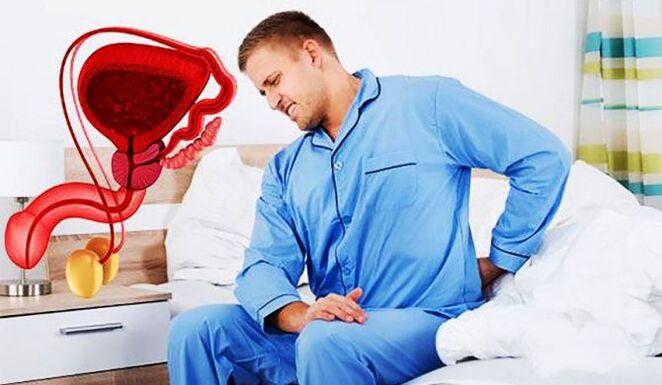
- along the urethral tract;
- in the perineum (the area between the base of the penis and the anus);
- in the lumbar or sacral area (often confused with radiculitis);
- in the lower abdomen, projection of the pelvis;
- in the scrotum area.
Each patient, in the event of such a pathology, experiences almost the same painful sensations each time.In some men, the pain is localized in only one place, while others experience all of the above symptoms at the same time.The pain often radiates to different parts of the body - leg, buttock, abdomen.
Attention!What symptoms a patient experiences with prostate inflammation is very important for a specialist.After all, if a man correctly describes his sensations, a qualified doctor can determine the form of the disease even by the nature of the painful manifestations.Thus, running pain most often indicates a non-infectious type of disease, and a feeling of fullness and burning indicates prostatitis of infectious origin.
Specific secretions
Pain syndrome is often accompanied by the appearance of pathological secretion.One of the characteristic signs of prostatitis is the appearance of various discharges - translucent, milky white, yellowish.Their consistency can be thick or stretchy.This symptom appears mainly after the passage of urine or feces.
Chronic inflammation of the gland can cause the development of spermatorrhea - in this case, a small amount of semen is released from the penis during defecation or in a state of muscle tension in the perineal area.
The presence of a greenish secretion mixed with pus indicates a sluggish, slow progression of the disease.Such secretions consist of dead leukocytes, damaged epithelial tissue cells, and mucus.Sometimes a similar phenomenon is observed during exacerbation of a chronic form of pathology.In this case, the patient’s temperature rises, pain and chills appear.In such a situation, you should visit a urologist as soon as possible, since the progression of signs of prostatitis in men can lead to sclerosis of the organ and the development of infertility.
Therapeutic measures
The treatment of the disease is selected by the doctor depending on the diagnosis.Various forms of prostate inflammation require an individual approach to therapy.To eliminate the symptoms of acute prostatitis in men, it is necessary to take antibacterial medications.It is best to use medications that penetrate well into this organ of the reproductive system.
When choosing an effective treatment regimen, a qualified doctor must pay attention to the patient’s immune system, take into account the nature of the disease, and the individual characteristics of the man’s body.Uncomplicated forms of inflammation of the prostate gland, in the acute course of the disease, can be treated at home.Patients with prostatitis are hospitalized only in severe cases, when they develop symptoms of severe intoxication.

This disease can also be treated using physiotherapeutic techniques - ultrasound, magnetic laser therapy.Popular methods include hirudotherapy and manual therapy (biopuncture, acupuncture).The use of medicinal herbs, the use of immunomodulatory and enzyme preparations, and cytotransmitters perfectly helps to get rid of any type of prostatitis.
In some situations, surgical treatment of prostatitis in men is performed.Surgery is performed if the patient is diagnosed with an abscess of this organ.For this purpose, drainage of the prostate gland is carried out using a trans-rectal (through the rectum) or trans-urethral method.In case of acute urinary retention, an epicystomy is performed - a hole is formed in the wall of the bladder to bring out a special suprapubic catheter.
Chronic inflammation of the prostate, which occurs without complications, can also be treated on an outpatient basis.But treatment of the disease in such a situation takes much longer.For treatment, suppositories, antibacterial agents, thermal methods, reflexology and gland massage are used.Patients who have suffered symptoms of prostatitis are advised to reconsider their lifestyle, give up bad habits, eat right, and avoid hypothermia.
Important!Do not self-medicate this pathology under any circumstances!Most often, inflammation begins to progress precisely as a result of symptomatic therapy and self-prescription of drugs.Antibacterial medications should be taken only under the supervision of a specialist, otherwise you can significantly weaken the body’s immune defense, which will become another problem for you and will only worsen the current situation.
The first signs of prostatitis in men - treatment of these manifestations should be timely.Such subtle symptoms pose a great danger, because they can arise not only as a result of inflammation of the prostate gland, but also with benign and malignant tumors of the organ.Therefore, it is so important to make a timely diagnosis and begin treatment of the pathology as soon as possible.After all, the sooner the patient consults a doctor, the faster the unpleasant and painful sensations will disappear and sexual life will normalize.